
AI-narrated version of this post using a synthetic voice. Great for accessibility or listening while busy.
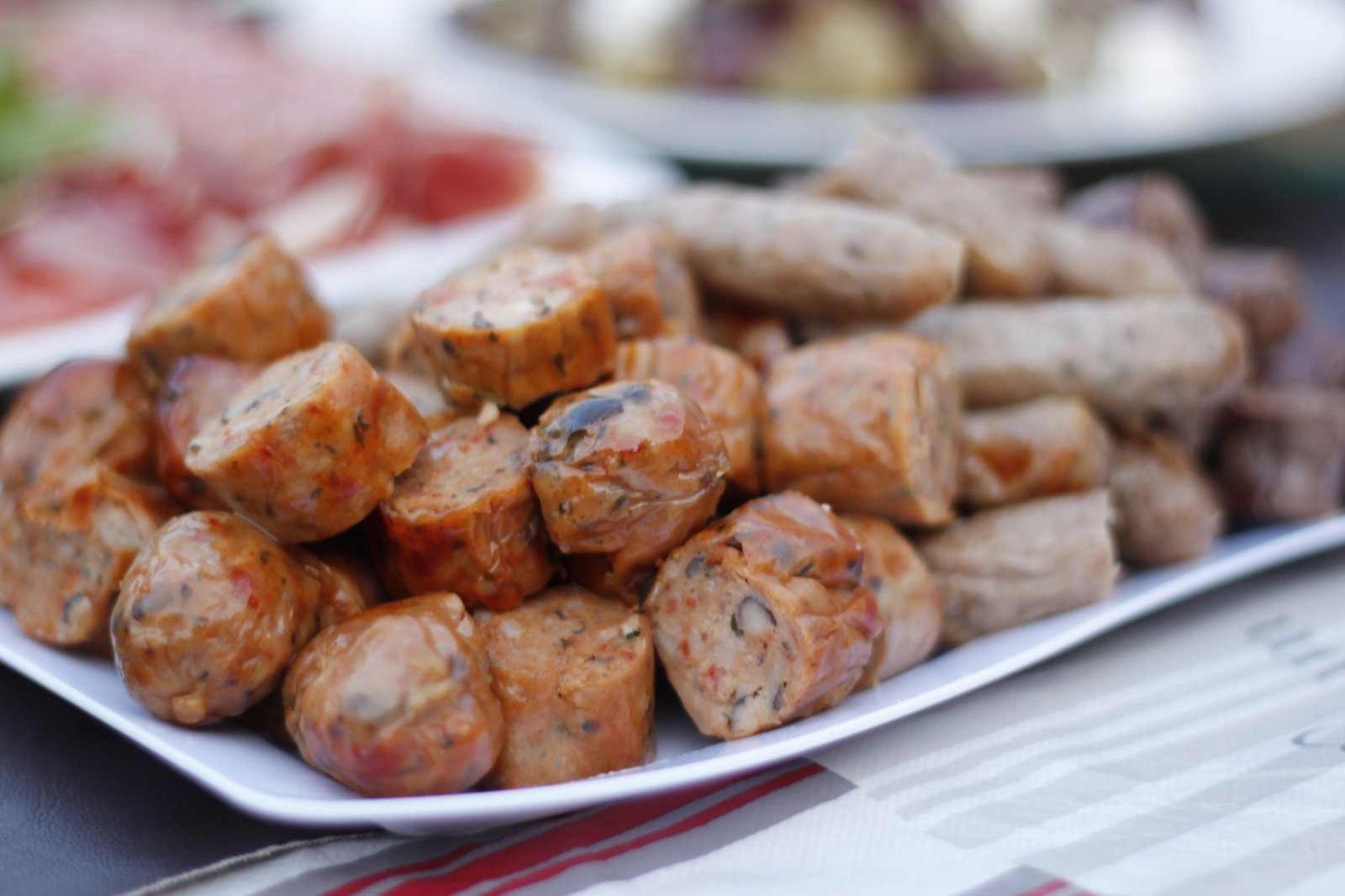
Photo: Kate / Pexels
Making Wild Game Sausage at Home: Fat Ratios, Casings, and Equipment
Late November in central Alberta, the garage becomes a second kitchen. Whitetail from the parkland WMUs around Camrose and Stettler, mule deer off the coulee country in the southeast, moose packed out of the boreal units north of Lac La Biche — most of it comes home as boneless trim in white game bags, and a lot of that trim is destined for the grinder. There is a reason sausage is the default end point for Alberta game: a mature mule deer buck yields a handful of premium steaks and then forty-plus pounds of shoulder, neck, shank and scrap that no amount of marinade is going to turn into tenderloin.
Sausage fixes that. It also exposes every shortcut you take. Wild game sausage fails for boringly predictable reasons — not enough fat, the wrong casing, a smeared grind, or a cure measured by eyeball. Here is how the pieces actually fit together.
Safety note: Hunting and firearms laws change and differ by location. Confirm current rules with official sources, and handle firearms and bows only with proper training and licences. See our legal notice. Outdoor activities carry real risk of serious injury or death. Check official conditions and regulations before you go, and do not rely on one piece of gear for your safety.
Why Alberta Game Needs Borrowed Fat
Deer, elk, moose and antelope carry very little intramuscular fat. Published figures for venison put raw lean around 2–4 percent fat; moose is leaner still. What fat these animals do carry sits as a hard subcutaneous and cavity layer, and it is almost entirely the wrong stuff for sausage. Game fat is high in stearic acid, melts at a temperature well above your mouth’s, and goes rancid fast in a freezer. It is the single most common source of that “gamey” tallow aftertaste people blame on the animal itself.
So the rule is blunt: trim game fat ruthlessly, along with silverskin, connective tissue and any blood-shot or hair-contaminated trim, then add pork fat back in. Pork fat melts lower, carries spice, and emulsifies into a proper bind. Beef fat is an option for summer sausage but behaves more like game fat — waxy, slow to melt.
Your two pork options are back fat (roughly 85–90 percent fat, firm, ideal for precise ratios) and pork shoulder/butt (roughly 20–30 percent fat, cheap, widely available, and it adds pork protein as well as fat). Hutterite colony outlets, independent butchers in towns like Innisfail and Wainwright, and the meat counters at most Alberta grocery chains will all sell shoulder; back fat usually needs a phone call to a butcher a few days ahead.
The Fat Ratios That Actually Work
Target total finished fat content of 20–30 percent by weight. Below about 15 percent, sausage turns crumbly, dry and chalky no matter how well you mix it. Above about 35 percent it renders out in the smoker and leaves a greasy, hollow casing.
Using pork back fat:
- 80:20 game to back fat — roughly 18 percent finished fat. Lean end of acceptable; works for snack sticks and pepperoni where a firm bite is wanted.
- 75:25 — roughly 22 percent. The reliable all-purpose ratio for smoked sausage, garlic rings and summer sausage.
- 70:30 — roughly 27 percent. Best for fresh bratwurst and breakfast links, where juiciness carries the product.
Using pork shoulder instead, you need far more of it, because shoulder is mostly lean. A 50:50 game to pork shoulder blend lands around 12–15 percent fat — serviceable for fresh sausage, borderline for smoked. A 60:40 game to shoulder, plus 10 percent back fat is the practical compromise most home processors settle into.
Weigh everything. A kitchen scale that reads to 1 gram and handles 5 kg is non-negotiable, because salt and cure are percentage-based and guessing on a 20 kg batch is how people ruin 20 kg.
Casings: Sizes, Types, and What to Buy
Casing diameter determines cook time, smoke penetration and how the product gets eaten. Match it to the sausage, not to whatever was on the shelf.
- Sheep casings, 22–24 mm — breakfast links and thin snack sausage. Delicate; they tear if you stuff aggressively.
- Hog casings, 32–35 mm — the workhorse. Bratwurst, Ukrainian garlic sausage, Italian, kielbasa. Natural, edible, and they give the snap people associate with good sausage.
- Collagen casings, 19–21 mm — edible, uniform, pre-tubed, and the standard for snack sticks. No soaking, no flushing, far less fussing.
- Beef middles, 55–65 mm — salami and larger cured product.
- Fibrous casings, 50–75 mm — summer sausage and bologna. Not edible; peel before slicing. They hold shape, take smoke well, and are the easiest path to a clean-looking summer sausage.
Natural casings arrive packed in salt and keep for a year or more refrigerated. Soak them in lukewarm water for at least 30 minutes, flush the interiors, then hold them in water while you work. Halford’s Hide & Leather in Edmonton has been the go-to Alberta source for casings, cure, seasoning premixes and stuffing tubes for decades, and most independent butchers will sell casings over the counter if you ask. Cabela’s locations in Edmonton and Balzac and the larger Peavey Mart stores carry grinders, stuffers and basic supplies seasonally, with stock thinning fast once general seasons open.
Grinders: What #8, #12 and #22 Actually Mean
Those numbers are head sizes, not horsepower. A #8 head takes roughly a 2 1/2 inch plate, a #12 takes about 2 3/4 inches, and a #22 steps up to roughly 3 1/4 inches with correspondingly bigger throat and auger.
For one or two deer a year, a #8 electric unit in the 0.35–0.5 hp range handles it. If you are grinding a moose, or splitting an elk with family, go #12 or #22 — a 0.75–1 hp #12 will move something in the range of 5–7 lb per minute and won’t bog on sinew. Kitchen-mixer grinder attachments will technically grind game, but they heat the meat and stall on connective tissue.
Plate sizes worth owning: 10 mm (3/8″) for the first coarse pass, 6 mm (1/4″) for general sausage, and 4.5 mm (3/16″) for a fine second pass on emulsified or snack-stick product. Keep knives and plates matched and sharp; a dull plate smears fat instead of cutting it, and smeared fat means a greasy, broken texture.
Temperature matters more than equipment. Meat and fat should be -2 to 2 °C going into the grinder — firm, crunchy at the edges, not frozen solid. Cube it, spread it on sheet pans, and put it in the freezer for 30–60 minutes first. Chill the auger, plate and knife too.
Stuffers: Why the Grinder Shouldn’t Do This Job
Stuffing through a grinder auger forces already-ground meat through the plate a second time, warming and smearing it. A dedicated vertical stuffer solves this. The common home sizes are 5 lb and 11 lb canisters; look for stainless steel gears rather than nylon, a two-speed gearbox, and an air-release valve in the piston.
Stuffing tubes should match the casing: roughly 3/8″ for sheep and collagen sticks, 3/4″ to 1″ for hog casings, and 1 1/2″ or larger for fibrous. Stuff firmly but not drum-tight — overstuffed casings split when the sausage swells during cooking.
Before any of that, the mix has to develop a bind. Add your salt, seasoning and roughly 10 percent cold water or crushed ice by weight, then mix until the mass turns visibly tacky and sticks to an upturned hand. That tackiness is extracted myosin, and it is the difference between sliceable sausage and meat gravel in a tube.
Cure, Salt and the Nitrite Rules You Don’t Improvise
Salt runs 1.5–2 percent of total meat weight — 15 to 20 g per kilogram. That is a flavour and function decision, not optional seasoning; salt drives the protein extraction described above.
Curing salt is a safety decision. Cure #1 (Prague Powder #1, pink, 6.25 percent sodium nitrite in salt) is used for anything that will spend extended time in the 4–60 °C range — low-temperature smoked sausage, summer sausage, snack sticks. The standard rate is 2.5 g of Cure #1 per kilogram of meat (about 1 level teaspoon per 2.27 kg / 5 lb), which lands near the 156 ppm nitrite ceiling. Cure #2, which adds sodium nitrate, is for long dry-cured, non-cooked product only.
Three hard rules: never scale cure by volume on large batches, never use Cure #1 in place of table salt, and never skip it on smoked sausage. Nitrite’s job is suppressing Clostridium botulinum in an anaerobic casing held at warm temperatures — exactly the conditions a smoker creates. Fresh sausage cooked straight through to temperature needs no cure at all.
Cook ground and sausage product to an internal 71 °C, verified with a probe thermometer, in line with Health Canada’s ground-meat guidance. Shower or ice-bath smoked sausage immediately after to stop the cook and set the casing.
CWD Testing and Cold-Chain Discipline
Chronic wasting disease is established in Alberta’s east-central and southern deer populations, and the province requires mandatory head submission for deer taken in a specific list of WMUs along and inward from the Saskatchewan border — that list changes between seasons, so confirm yours. Health authorities advise against consuming meat from animals that test positive.
The practical implication for sausage makers: do not grind and blend animals together until results are back. Mixing an untested deer into a 20 kg batch means one positive result writes off everything. Keep carcasses separate and labelled by animal and WMU. Note also that Alberta’s Wildlife Act prohibits selling or trafficking in wild game meat — home sausage is for your household and sharing, never for sale, and that extends to farmers’ market tables and online swaps.
Storage and Realistic Freezer Life
Vacuum sealing beats everything else, because game sausage fails by fat oxidation long before it fails microbially. Hold the freezer at -18 °C or colder. Rough expectations at that temperature:
- Fresh, uncured sausage: 3–4 months vacuum sealed before flavour degrades noticeably.
- Cured and smoked sausage: 6–9 months, sometimes longer.
- Snack sticks and summer sausage: 6 months frozen; refrigerate opened product and eat within a couple of weeks.
Label every package with the date, the animal, the WMU and the fat ratio. The last item sounds fussy until next season, when you want to know why the 2025 brats were better than the 2024 batch.
Hunting disclaimer: This article is informational, not instructional. PickinRocket does not provide guidance on taking, shooting or dispatching animals. Hunting in Alberta requires valid licences, tags, course certification where applicable, and compliance with all season dates, WMU boundaries and transport requirements. Food-safety and curing information here is a general overview, not professional food-safety certification — if you are unsure about cure calculations, consult a qualified butcher or food-safety authority before processing a large batch.
Important: Verify Current Rules
Alberta’s hunting regulations, CWD mandatory-submission WMU lists, and game-meat handling requirements change from season to season. Before you hunt or process, confirm current rules with the Alberta Guide to Hunting Regulations and the Alberta government’s wildlife disease pages, and check Health Canada or Alberta Health Services for current food-safety and curing guidance. Nothing in this article replaces the official regulations in force on the day you are in the field or in the garage.
General information only, not professional advice. Details can change or contain errors, so check with the manufacturer or an official source before you rely on them. Use of this site is subject to our Disclaimer and Terms of Service.