
AI-narrated version of this post using a synthetic voice. Great for accessibility or listening while busy.
Affiliate disclosure: PickinRocket participates in the Amazon Services LLC Associates Program. As an Amazon Associate we earn from qualifying purchases. Prices and availability are accurate at publish time but may change.
A rifle scope is the one piece of gear on this list where “good enough” and “actually good” are separated by things you can’t tell from a spec sheet in a store – glass clarity in low light, how the reticle holds up past 300 yards, whether the turrets actually track true when you dial for elevation. Buy the wrong scope and you won’t know it until the one moment it matters: last light on a mule deer working a coulee edge, or a longer crossing shot than the range you sighted in at. This guide breaks scopes down by what you’re actually hunting and how far you’re realistically shooting, not just by price.
Hunting requires Alberta Hunter Education certification, a valid licence, and the applicable WMU tag or draw allocation. This article covers optics buying decisions only – it is not instruction on shot placement or harvesting an animal.
Who Needs to Spend More, and Who Doesn’t
If most of your hunting happens in timber or thick parkland where shots rarely stretch past 150 yards – a lot of central Alberta whitetail hunting falls into this bucket – a mid-range fixed or low-variable scope does the job completely, and spending more buys very little you’ll actually use. Where the extra cost earns its keep is open country: foothills mule deer, prairie pronghorn, or any hunt where you might genuinely need to judge and hold for wind and distance past 300 yards. Glass quality matters most in the thirty minutes around dawn and dusk, exactly when a lot of big game moves – a budget scope that looks fine at noon can go noticeably dim in that window, while better glass stays usable.
Comparison: Scope Tiers by Use Case
| Tier | Price range | Magnification range | Best for | Where it falls short |
|---|---|---|---|---|
| Entry-level fixed/variable | $80-$180 | 3-9x | Timber and parkland whitetail, shots under 150 yds | Dims noticeably in low light, less precise turrets |
| Mid-range variable | $200-$400 | 3-9x to 4-12x | Most Alberta big game hunting, mixed terrain | Not built for serious long-range work |
| Upper-mid long-range capable | $400-$700 | 4-16x to 5-25x | Open-country mule deer, elk, pronghorn | Heavier, higher price for capability many won’t use |
| Premium | $700-$1,200+ | Varies | Guided/backcountry hunts, dedicated long-range setups | Diminishing returns for most WMU-based hunts |
What Actually Matters on a Spec Sheet
Objective lens size – the second number, like the “40” in 3-9×40 – controls how much light reaches your eye. Bigger generally means brighter in low light, but also heavier and higher off the bore, which changes how you mount and use it. Tube diameter (1 inch vs 30mm) affects how much internal adjustment range you have for dialing elevation and windage; 30mm has become the practical standard for anything mid-range or above. Turret type matters more than most buyers realize: capped turrets are fine if you sight in once and leave it, but if you plan to dial for distance in the field, exposed turrets with audible clicks are worth paying for.
Budget for Mounting and Sighting-In, Not Just the Scope
A scope’s price tag is never the full cost. Rings or a one-piece mount ($30-$150 depending on quality and whether you need extra height for a large objective lens), plus either a range session or a bore-sighting tool to get you close before live rounds, add real cost on top of the glass itself. Skimping on mount quality is a common mistake – a scope can only hold zero as well as what it’s clamped into, and a cheap mount can undo an otherwise good scope’s tracking accuracy.
Reticle Types: What the Options Actually Mean
A duplex or basic crosshair reticle is genuinely all most Alberta hunters need – simple, fast to use, and not distracting in a quick shot situation. BDC (bullet drop compensating) reticles add hash marks calibrated to specific drop points at different ranges, which is useful if you’re willing to actually learn your rifle’s real trajectory against those marks rather than assuming they’re universal – they’re calibrated to a specific cartridge and load, and using them with a different load than they’re designed for defeats the purpose. First-focal-plane reticles, common on higher-end long-range scopes, scale with magnification so holdover marks stay accurate at any zoom level, versus second-focal-plane reticles where those marks are only accurate at one specific magnification, usually maximum. For most hunters sighting in once and shooting inside a few hundred yards, a simple duplex reticle on a second-focal-plane scope remains the least complicated, most reliable choice.
Common Mistakes When Buying a Hunting Scope
The most common mistake is buying a scope with more magnification than the hunting situation calls for – a 6-24x scope is genuinely harder to use for a fast shot at moderate range than a 3-9x, because finding your target in a narrow high-power field of view under pressure takes practice most hunters don’t get. The second is skipping a proper mount or cheaping out on rings, which undermines even good glass. The third is buying based on magnification number alone without checking eye relief, especially on a hard-kicking rifle – inadequate eye relief on a scope mounted too close is a genuine way to get hurt on recoil, not just an inconvenience. Read the eye relief spec before buying, particularly for larger calibers.
Best Entry-Level Pick: Budget Fixed/Variable Scope

- Adjustable Illuminated Setting: Green and red illuminations, 5-level brightness available, allow the hunter to use normally in…
- Clearer View: Magnification: 3X to 9X. Objective lens: 40mm. Field of view: 13.41-40.38ft @ 100 yards. Equipped with the multi-…
- Accurate & Rapid Aiming: Capped reset turrets are finger adjustable with MOA clicks that can be reset to zero after sighting in…
For a straightforward timber or parkland whitetail setup where shots stay inside 150 yards, this class of scope covers the job without spending money on capability you won’t use. Expect clear glass in daylight, adequate but not exceptional low-light performance, and turrets meant to be sighted in once and left alone rather than dialed in the field. It’s the right call for a second rifle, a youth hunter’s first setup, or anyone whose hunting genuinely stays inside typical bush-country ranges.
Best Value: Mid-Range Variable Scope

- The 3-9×40 Crossfire II riflescope is one of many configurations in the Crossfire II line. The V-Plex reticle is a popular all-…
- With long eye relief and an ultra-forgiving eye box, you’ll be able to quickly get a sight picture and acquire your target. The…
- Anti-reflective, fully multi-coated lenses provide bright and clear views for the user.
This is the scope most Alberta hunters should actually own – enough magnification range to handle everything from a close timber shot to a longer crossing shot across a cutline, glass that holds up reasonably well in early morning and late evening light, and turrets precise enough to trust for a small correction. It covers whitetail, mule deer, and most elk hunting in mixed terrain without asking you to pay for long-range capability most Alberta hunts don’t require.
Best for Open Country: Upper-Mid Long-Range Capable Scope
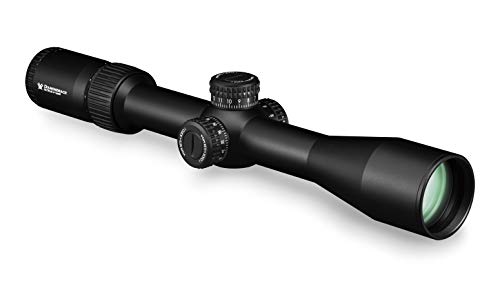
- The Diamondback Tactical First Focal Plane 4-16×44 stands at the intersection of precision and value, delivering an impressive…
- Extra-low dispersion glass and fully multi-coated lenses transmit a crisp, bright sight picture. The first focal plane, glass-e…
- The precision-glide erector system uses premium components in the zoom lens to ensure smooth magnification changes under the ha…
Foothills and prairie hunters chasing mule deer or pronghorn across open ground benefit from the extra magnification top-end and brighter glass this tier offers, along with turrets built to be dialed confidently rather than just sighted in and forgotten. It’s a real step up in weight and price, and unnecessary if your hunting stays in timber – but for anyone regularly glassing and then shooting across genuinely open terrain, it closes the gap between what you can see and what you can accurately shoot.
Best Premium Option: Long-Range Hunting Scope
Availability and specific models shift often enough that we’re pointing you to live search results rather than a single listing that could be discontinued.
At the top of this list is glass built for hunters who want serious long-range capability from the start – first-focal-plane reticles, exposed turrets with locking mechanisms, and objective lenses sized for genuinely low light. This is overkill for the average WMU whitetail hunt, and worth it specifically for guided backcountry hunts, dedicated open-country mule deer or sheep hunting, or anyone building a rifle around long-range capability rather than adding it as an afterthought.
Best Compact/Lightweight Pick
Availability and specific models shift often enough that we’re pointing you to live search results rather than a single listing that could be discontinued.
For backcountry or spot-and-stalk hunts where every ounce in the pack matters, a compact scope trades some low-light performance and adjustment range for meaningful weight savings on the rifle itself. It’s a reasonable tradeoff for hunters covering serious ground on foot, and not the right pick if low-light performance matters more than carry weight for your specific hunt.
Warranty and What Happens When Glass Fogs or a Turret Fails
Most established optics brands back their scopes with a meaningful warranty, and it’s worth understanding what that actually covers before you buy rather than after something goes wrong. Internal fogging, usually caused by a seal failure letting moisture in, is the most common failure mode on lower-cost scopes and is almost always covered under a lifetime or limited-lifetime warranty from a reputable brand. Turret failure – clicks that stop tracking true, or a turret that physically loosens over time – is less common but more disruptive, since it can silently throw shots off without an obvious symptom until you’re checking zero and can’t explain the drift. Register your purchase where the brand allows it, keep the receipt, and periodically confirm zero at the range rather than assuming a scope that was accurate last season still is; a turret or mount that’s shifted slightly is one of the more common, least obvious reasons for a missed shot that gets blamed on everything except the equipment.
Which One to Actually Buy
For the majority of Alberta hunters working timber, parkland, or mixed terrain inside 200 yards, the mid-range variable scope is the sensible default – it covers essentially every realistic shot without paying for capability that goes unused. Foothills and open-country hunters chasing mule deer or pronghorn get real, usable benefit from stepping up to the long-range capable tier. Save the premium glass for backcountry or guided hunts where the extra low-light performance and precision genuinely change outcomes, and consider the compact option only if pack weight is a bigger constraint than optical performance for your specific hunt.
Hunting requires Alberta Hunter Education certification, a valid licence, and the applicable WMU tag or draw allocation. Regulations, seasons, and firearm/archery equipment rules can change — confirm current requirements at alberta.ca/hunting before you head out.
Related Auburn AI Products
Running an affiliate content site and want to scale? Auburn AI has kits for operators: