
Affiliate disclosure: PickinRocket participates in the Amazon Services LLC Associates Program. As an Amazon Associate we earn from qualifying purchases. Prices and availability are accurate at publish time but may change.
A canoe tips over if you shift your weight wrong. A kayak puts your legs under the deck, which is a problem the moment a big pike or a stray hook is involved. Wading works until the water gets too deep or too cold to stand in for six hours straight. A one-person pontoon or small boat solves a specific problem: getting off the bank and onto open water on lakes like Pigeon, Chestermere, or the smaller Crown-land lakes scattered through the parkland, without hauling a trailer or paying for a boat launch permit every trip.
This isn’t a guide to full-size dock-and-trailer pontoon boats – those are dealer purchases, not something that ships to your door. It’s about the gear that actually does ship: inflatable pontoons you strap into like a lawn chair with oars, small rigid hull jon boats you can lift into a truck bed, and inflatable dinghies that pack down into a duffel bag. All of it sits in the $250 to $1,200 range depending on how far you want to go from shore and how much gear comes with you.
Who Actually Needs One
If you fish exclusively from a dock, a bridge, or a spot you can reach on foot, save your money – none of this gear fixes a problem you don’t have. Where a pontoon or small boat earns its keep is water that’s too far to cast to from shore: the back bay on a stocked lake where the pike hold up, a stretch of river you can’t wade, or a small lake with zero public shoreline access. It’s also one of the cheapest legal ways to fish moving water without a powerboat.
Skip this category if you’ll be fishing water with real boat traffic or wind exposure – a one-man pontoon on a windy afternoon on a big reservoir like Gull Lake is a genuinely bad time, and a hard-hull boat with a real motor is the safer call there.
Comparison: What You’re Actually Choosing Between
| Type | Price range | Setup time | Best for | Watch out for |
|---|---|---|---|---|
| Belly boat / float tube pontoon | $200-$450 | 5-10 min | Small stillwater, float fishing, backcountry lakes you hike into | Sitting low in the water; cold-weather use needs waders |
| Inflatable pontoon boat (frame + seat) | $400-$900 | 15-20 min | Day trips on lakes, some river float fishing | Bulkier to transport than a belly boat |
| Rigid hull mini jon boat | $500-$900 | None (car-top or trailer) | Small lakes, calmer rivers, hauling more gear | Needs roof racks or a small trailer, no packing down |
| Larger inflatable pontoon w/ motor mount | $700-$1,200+ | 20-30 min | Bigger stillwater, all-day trips, small electric motor use | Heaviest and slowest to inflate/deflate |
Weight Capacity Is the Number That Actually Matters
Every pontoon and small boat lists a maximum weight capacity, and it’s tempting to buy right up to that limit. Don’t. That number usually reflects the boat floating level with everything strapped down and nobody moving – not the boat performing well with a full-grown adult, a tackle bag, a cooler, and a rod case all shifting around while you cast and net fish. A rough rule that holds up in practice: subtract 25-30% from the stated capacity to get a realistic working load. A boat rated for 400 lbs should be treated as a 280-300 lb boat once you’re actually fishing out of it. Undersizing on capacity is the single most common reason people end up disappointed with an inflatable pontoon.
Transport and Storage Before You Buy
The best boat on paper is the one you’ll actually take out, and that comes down to how it fits your vehicle and where it lives between trips. Inflatables need a dry, ventilated spot to store – a damp garage corner will eventually cause mildew on the material even with a good rinse after each use. Rigid hulls need either roof rack capacity your vehicle actually has or a small trailer, plus somewhere to park it that isn’t blocking a driveway all summer. Work this out before you buy rather than after; a boat you can’t easily get to the water stops getting used within a season.
Materials: PVC vs Hypalon/CSM Fabric
Inflatable pontoons and boats are built from one of two main fabric types, and the difference matters more than most first-time buyers realize. PVC is lighter and less expensive, holds up fine for recreational use, and is what most budget-to-mid-range pontoons use – the tradeoff is more sensitivity to UV exposure over years of use and slightly less resistance to abrasion against rocks or dock edges. Hypalon, or its modern equivalent CSM-coated fabric, costs more but resists UV degradation and abrasion noticeably better over a multi-year lifespan, which is why higher-end pontoons and dinghies often use it. For a boat that’s stored properly and not left inflated in direct sun all summer, PVC is a perfectly reasonable choice and the price savings are real. For a boat headed for years of hard use, frequent rocky put-ins, or extended sun exposure, the upgrade to Hypalon-family material pays for itself in extended usable life.
Oars, Paddles, and the Accessories That Aren’t Always Included
Read the fine print on what actually ships with a given model – some pontoons and small boats include oars or a pump, others sell them as separate add-ons, and discovering that gap after the box arrives is a common source of frustration. A quality pair of oars or a paddle matched to the boat’s width matters more than it seems; undersized oars make a wide pontoon frustrating to maneuver against any wind or current. If a foot or electric pump isn’t included, budget for one separately – manually inflating a larger pontoon with a hand pump is a genuinely tiring way to start a fishing trip.
Best Budget Entry: Belly Boat Style Pontoon
Availability and specific models shift often enough that we’re pointing you to live search results rather than a single listing that could be discontinued.
Search on Amazon →This is the cheapest real way into pontoon fishing, and for a lot of Alberta stillwater anglers it’s also the only one they’ll ever need. You sit inside a U-shaped frame with your legs in the water or in waders, propel yourself with swim fins, and carry it in rather than launching it. Setup is genuinely five minutes. The tradeoff is exposure – you’re sitting close to the waterline, so this is a fair-weather, calm-water tool, not something for a cold October afternoon on open water. For small lakes, ponds, and float-fishing a slow river stretch, it does the job at a fraction of the cost of anything else on this list.
Best All-Around: Frame-Mounted Inflatable Pontoon
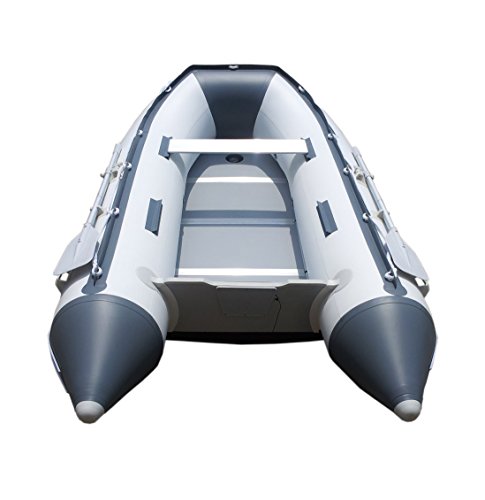
- USCG rated triple layered 0.9mm/1,100 denier specialty coated PVC, marine wood flooring Inflatable sport boat tender.
- Includes: Aluminum Framed Marine Wood Flooring, 1 aluminum bench seat, 2 aluminum oars, carrying & storage bag, foot pump, drai…
- Materials: Boat: Triple Layered 0.9mm / 1,100 denier Polyester reinforced and anti corrosive coated PVC. Material ensures prote…
The step up from a belly boat adds a proper seat above the waterline, oars instead of fins, and enough stability to stand briefly to net a fish. This is the pick most anglers land on if they’re buying one boat to cover the most water types – it packs down small enough for the trunk of a car, sets up in under twenty minutes, and holds enough weight capacity for a cooler and a rod case alongside you. It’s not fast and it’s not meant to cover long distances, but for a day of working the shoreline of a stocked lake or drifting a slow stretch of river, it’s the most versatile option in this price range.
Best for Hauling More Gear: Rigid Hull Mini Jon Boat
Availability and specific models shift often enough that we’re pointing you to live search results rather than a single listing that could be discontinued.
Search on Amazon →If inflating and deflating a boat every trip sounds like a chore, a small rigid hull jon boat skips that entirely – strap it to a roof rack or a small trailer and it’s ready the moment it hits the water. These typically hold more capacity than an inflatable in the same price bracket, which matters if you’re bringing a second person, a dog, or enough gear for a full day. The tradeoff is transport and storage: this isn’t something you fold into a closet, and without a trailer, getting it to and from the water means lifting real weight. Worth it if you have somewhere to store it and a vehicle set up to carry it.
Best for Bigger Water and Longer Days: Motor-Ready Inflatable Pontoon

- 【Built-to-last Construction】 The fishing boat is crafted with premium PVC and 600D polyester on its surface, ensuring it can wi…
- 【Enhanced Control & Motor-ready Design】 Included are 2 aluminum oars for effortless steering. Also, there are oar locks to free…
- 【Padded Seat & Adjustable Footrest】 The padded seat and backrest allows you to sink into the plush embrace. Also, the PU leathe…
This tier adds a transom or motor mount rated for a small electric trolling motor, plus a larger frame and higher weight capacity. It’s the right call for anglers who want to cover more of a lake than oars alone allow, or who are fishing longer days and want the option to motor back if the wind picks up. It’s the heaviest and slowest to set up of everything here, so it suits people with a truck and a fixed put-in spot more than backcountry access where you’re carrying gear in.
Best Ultralight Packable Option: Inflatable Dinghy / Kayak-Style Boat

- COMPLETELY INFLATABLE, PORTABLE, STORABLE AND TRANSPORTABLE. Can be stowed in the back of most cars and in relatively small spa…
- NOW WITH A 6 INCH DEEP, high-pressure, rigid, external, inflatable keel with protective keel guard to increase performance and…
- COMPRISED ENTIRELY of double-layer, high-pressure, fusion technology, all-drop-stitch technology and weights only 95 lbs with t…
For anglers who hike or paddle into backcountry water where a car isn’t an option, an ultralight inflatable that rolls down into a duffel bag under 20 lbs is worth the tradeoff in stability and gear capacity. It won’t hold up to the abuse a rigid hull takes, and most models aren’t rated for anything but calm water, but for reaching a lake nothing else on this list could get to, it’s the only realistic option.
Which One to Actually Buy
For most Alberta stillwater anglers fishing solo on lakes and slow rivers, the frame-mounted inflatable pontoon is the sensible default – it’s the widest-use option for the money. If your fishing is exclusively small, calm ponds and cost is the deciding factor, the belly boat gets you on the water for less than half the price. If you’ve got a truck, a place to store a hard hull, and want zero setup time trip after trip, the rigid jon boat pays that convenience back every single outing. And if the water you want to fish isn’t reachable by vehicle at all, the packable inflatable is the only entry on this list built for that job.
Boating and watercraft regulations, PFD requirements, and access rules vary by waterbody and can change. Confirm current rules at alberta.ca/fishing before you head out.
Related Auburn AI Products
Running an affiliate content site and want to scale? Auburn AI has kits for operators: