
AI-narrated version of this post using a synthetic voice. Great for accessibility or listening while busy.
Affiliate disclosure: PickinRocket participates in the Amazon Services LLC Associates Program. As an Amazon Associate we earn from qualifying purchases. Prices and availability are accurate at publish time but may change.
A single-person squeeze filter that’s perfectly adequate for a weekend trip becomes a genuine chore on a five-day backcountry hunt or an extended multi-day hike — constant refilling, a filter that clogs faster under heavier use, and for water sources with any real risk of viral contamination, a filter alone that isn’t actually rated to remove them. This is specifically about what’s changed for longer trips and higher-volume needs: purification versus filtration, and capacity built for days rather than a single overnight.
Filter vs. Purifier: A Distinction Worth Actually Understanding
A water filter physically strains out bacteria and protozoa — organisms large enough to be caught by a fine enough filter membrane — but most filters aren’t rated to remove viruses, which are small enough to pass through typical filter pore sizes. In most of backcountry Alberta and Canada generally, viral contamination risk in surface water is low enough that a quality filter is genuinely sufficient for the vast majority of trips. A purifier goes further, using chemical treatment, UV light, or an electroabsorptive method to also neutralize viruses, which matters more for international travel or water sources with higher contamination risk than typical Canadian backcountry water. Know which one you actually need before paying extra for purification capability that a given trip doesn’t call for.
Comparison: Extended-Trip Water Treatment Options
| Type | Price range | Group size | Best for |
|---|---|---|---|
| Purifier bottle (press/squeeze) | $70-$100 | Solo to small group, refilled repeatedly | Fast individual purification on the move |
| High-capacity squeeze filter | $30-$50 | Solo to duo | Lightweight, high daily volume, filtration only |
| Higher-flow filter bottle | $30-$50 | Solo | Simple, filter-only, no purification |
| Gravity filter system | $80-$130 | Group of 3-6+ | Camp-based filtering for multiple people at once |
| UV purifier pen | $80-$130 | Solo to small group | Fast purification of clear water, needs battery/charge |
Why Extended Trips Change the Calculation
A weekend trip rarely stresses a filter enough to reveal its real-world flow-rate decline as it clogs with sediment, but a five-day or longer trip absolutely will — most filters lose flow rate progressively as particulate builds up in the membrane, and a filter that started fast can slow to a frustrating trickle by day four without regular backflushing. Higher-capacity systems, or filters specifically designed with easier field-cleaning in mind, matter more the longer a trip runs. Group size compounds this further: a single squeeze filter that’s fine for one person becomes a bottleneck for four people all needing water twice a day, which is exactly where a gravity system’s ability to filter several liters passively while you set up camp becomes worth its added weight and bulk.
Best for Fast Individual Purification: Grayl UltraPress

- MAKE SAFE DRINKING WATER from virtually any freshwater source globally. Ultimate performance, portability, and convenience. Ide…
- FAST & EASY TO USE: Fill. Press. Drink! – ‘Fill’ from any sketchy freshwater source; ‘Press’ on a low surface (e.g. ground), th…
- REMOVES WATERBORNE PATHOGENS: 99.9% of viruses (e.g. rotavirus, norovirus, hepatitis A), 99.9999% of bacteria (e.g. E. Coli, sa…
Using a press mechanism that purifies roughly 16-24 ounces in under ten seconds, the UltraPress covers both filtration and purification in one device without pumping, squeezing through a separate pouch, or waiting on UV treatment time. For solo travelers or hunters wanting the broadest protection with the least process, it’s the least fussy purifier on this list, at the tradeoff of a higher per-fill cost in replacement cartridges over an extended trip.
Best Lightweight High-Volume Filter: LifeStraw Peak Series Squeeze
Availability and specific models shift often enough that we’re pointing you to live search results rather than a single listing that could be discontinued.
Built for higher daily water volume than LifeStraw’s original straw-style product, the Peak Series Squeeze pairs with standard bottle threads for a genuinely fast fill-and-drink process across a long day. It’s filtration only, not purification, which is the right tradeoff for most Canadian backcountry water sources and keeps weight and cost down compared to a full purifier.
Best for Simplicity: Katadyn BeFree 3L
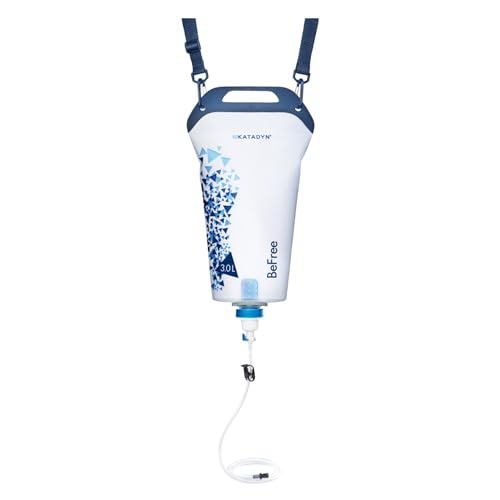
- HANDS-FREE GRAVITY WATER FILTER SYSTEM: The BeFree Gravity 3L is a complete water filtration system for backpacking, camping, a…
- FILTERS FOR CLEAN, CLEAR WATER: The 0.1 micron EZ-Clean hollow fiber filter processes water from streams, lakes, and rivers at…
- LIGHTWEIGHT AND PACKABLE: The 3L collapsible water bag packs flat when empty and is ideal for solo or small group trips. Hang f…
The larger 3-liter version of Katadyn’s BeFree line trades some of the packability of smaller filter bottles for real capacity, meaningfully reducing how often you’re stopping to refill on a multi-day trip. Its hollow-fiber membrane has one of the fastest flow rates in the filter-only category when clean, whether used in the squeeze bottle format or the gravity-fed version of the same BeFree filter, though like all hollow-fiber filters it benefits from regular field cleaning to maintain that speed across an extended trip.
Best for Group Trips: Platypus GravityWorks 4L

- High-capacity, gravity-fed, hollow-fiber water filter system ideal for group and family camping, outdoor adventures, and emerge…
- Meets all EPA/NSF guidelines for removal of 99.9999% of bacteria and 99.9% of protozoa, including giardia, cryptosporidium, E….
- No pumping required; reservoir fills easily and hangs from a tree to deliver six liters of filtered water for cooking and washi…
Rather than requiring active pumping or squeezing, a gravity system filters passively while hung at camp — fill the dirty reservoir, hang it, and let gravity push water through the filter into a clean reservoir while you handle other camp tasks. For a group of three or more on a multi-day trip, this passive capacity is a genuine time and effort savings that scales far better than everyone individually squeezing their own bottle multiple times a day.
Best for Fast Purification of Clear Water: SteriPen Classic 3

- UV WATER PURIFIER FOR CAMPING HIKING AND TRAVEL: The workhorse of the SteriPen family, the Classic 3 uses UV-C light to purify…
- AA BATTERY POWERED FOR ANYWHERE-ON-EARTH RELIABILITY: Runs on 4 AA alkaline (25 treatments), lithium (150 treatments), or recha…
- LED INDICATOR PANEL CONFIRMS EVERY TREATMENT: The panel shows treatment size, battery level, and UV lamp life remaining so you…
A UV purifier treats water by neutralizing pathogens with ultraviolet light rather than physically filtering them out, working fastest on already-clear water and less reliably on water with heavy sediment that can shield organisms from full UV exposure. It requires a charged battery to function at all, which is a real dependency to manage on an extended trip without charging access — worth carrying a backup treatment method alongside it for that reason alone, not as a knock against the technology itself.
Planning Daily Water Volume for a Group
Underestimating how much water a group actually needs per day is a common planning mistake that puts real strain on any filtration or purification system, regardless of how good the device itself is. A reasonable baseline for active backcountry travel is roughly 3-4 liters per person per day, more in hot weather or at higher exertion levels, and that number needs to cover drinking water, meal rehydration, and basic cleanup, not just sipping through the day. For a group of four on a multi-day trip, that’s 12-16 liters daily passing through whatever treatment system is being used, a volume that makes the case for a gravity system’s passive capacity even stronger than the group-size comparison alone suggests. Running the actual math before a trip, rather than assuming any single device will keep up regardless of group size, avoids discovering a capacity shortfall on day two rather than during planning.
Bottle and Container Compatibility
Squeeze filters and filter bottles are often designed around a specific thread pattern, and not every filter attaches cleanly to every water bottle or hydration reservoir on the market — a filter that only threads onto its own branded bottle limits your options if that specific bottle cracks or gets lost mid-trip, while filters built around widely-used standard threading offer more flexibility to improvise with whatever container is actually available in the field. Check compatibility with any hydration bladder or bottle you already own and plan to use before committing to a specific filter system, particularly for a multi-day trip where losing or damaging the one purpose-built bottle a filter depends on would otherwise leave the whole system unusable until you’re back at a vehicle.
Taste and Odor: Chemical Tablets as a Backup, Not a Primary
Chemical purification tablets, typically chlorine dioxide or iodine-based, are worth carrying as a lightweight backup precisely because they need no moving parts, no battery, and no membrane to clog — but they come with a real tradeoff in taste and wait time that makes them a poor primary method for regular use. Iodine-based tablets in particular leave a noticeable taste many people find unpleasant across repeated daily use, and most tablet formulations require a wait of thirty minutes to several hours before water is safe to drink, which doesn’t fit the fill-and-go pace filtration and most purifiers offer. A small bottle of neutralizing agent, sold alongside many tablet products specifically to offset iodine taste, is worth adding to a kit if tablets are the planned backup method for an extended trip — it’s a small weight addition that meaningfully improves whether the backup method actually gets used rather than avoided when the primary system is working fine.
Cold Weather Performance: A Real Limitation Most Buyers Don’t Consider
Filter membranes, especially hollow-fiber designs used in most squeeze filters and filter bottles, can be permanently damaged if they freeze while still wet — ice crystals forming inside the tiny fiber structure rupture it, and a frozen-then-thawed filter can fail without any obvious external sign of damage, silently letting contaminants through afterward. This is a real, specific risk for shoulder-season and late-fall Alberta trips where overnight temperatures can drop below freezing even when daytime conditions feel mild. Sleep with a filter inside your sleeping bag or otherwise insulated on any night where freezing is possible, and if a filter has frozen while wet, treat it as compromised and switch to a backup method rather than trusting it for the rest of the trip. UV purifiers and chemical tablets aren’t vulnerable to this specific failure mode, which is worth factoring in for cold-weather trips specifically.
Field Cleaning and Maintenance: The Difference Between a Filter That Lasts and One That Doesn’t
Most filters lose flow rate as sediment builds up in the membrane, and nearly all of them can be at least partially restored by backflushing — pushing clean water in the reverse direction through the filter to dislodge trapped particulate. Carrying the specific backflushing syringe or attachment that came with a given filter, rather than assuming a rinse under a water source will do the same job, makes a real difference in how long a filter stays usable across a multi-day trip. Pre-filtering visibly silty or debris-heavy water through a bandana or dedicated pre-filter before it ever reaches the main filter also extends usable life significantly, and is a habit worth building specifically on trips where water sources are murkier than the clear mountain streams filter marketing photos tend to depict.
Backup Method: Never Rely on One System for a Long Trip
Any single water treatment method can fail in the field — a filter can clog beyond field-cleaning capability, a UV pen’s battery can die, a purifier’s cartridge can run out faster than expected on a longer-than-planned trip. Carrying a lightweight chemical treatment backup, like purification tablets, adds negligible weight and solves a genuine single point of failure that a lot of trip planning overlooks entirely. This matters more, not less, the longer and more remote a trip is, since a failed primary system on day one of a two-day trip is an inconvenience, while the same failure on day four of a week-long backcountry hunt is a real problem.
Which One to Actually Buy
For solo travelers or hunters wanting genuine purification with minimal process, the Grayl UltraPress is the least complicated option on this list. Anyone confident that filtration alone covers their specific trip’s risk profile gets excellent daily performance from the LifeStraw Peak Series Squeeze or the higher-capacity Katadyn BeFree 3L. Group trips of three or more should prioritize a gravity system like the GravityWorks 4L over everyone carrying individual filters — the passive capacity difference is significant once trip length and group size both increase. And regardless of primary system, carry a lightweight chemical backup on anything longer than a weekend trip; it’s cheap insurance against the one failure mode every device on this list shares.
Backcountry access, Crown land camping, and public land use rules can change seasonally. Confirm current requirements at alberta.ca before you head out.
Related Auburn AI Products
Running an affiliate content site and want to scale? Auburn AI has kits for operators: